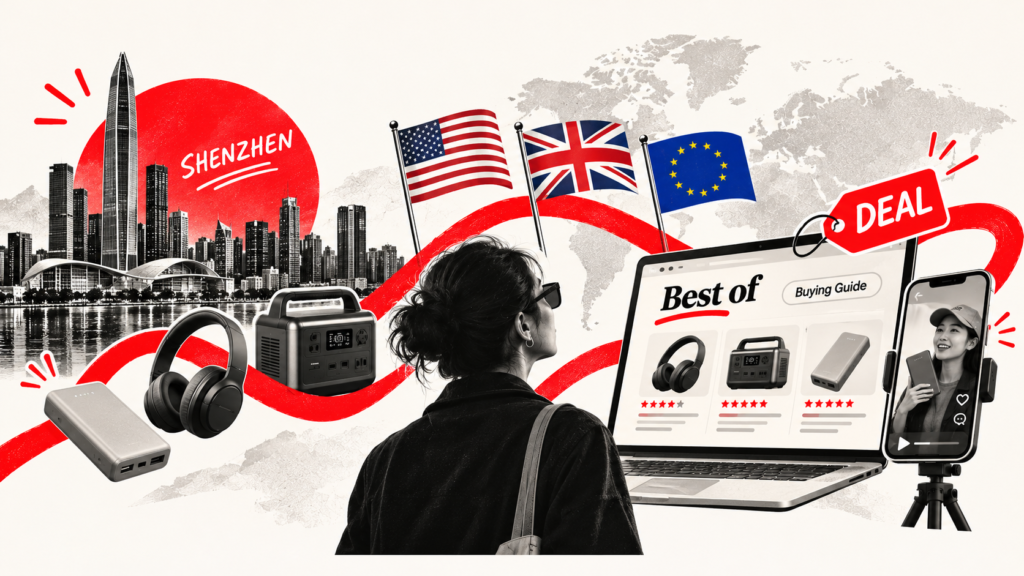
Chinese brands already make many of the products Western shoppers buy every day: chargers, headphones, power stations, robot vacuums, smart home kit. Many of them sell well on Amazon. But most are invisible in the places Western shoppers go before they buy: the review sites, buying guides, deal platforms and creators they trust.
That is what affiliate marketing fixes. A tech reviewer tests your product and includes it in a “best of” guide. A deal site features your Black Friday offer. A creator links to your product in a video. Each one earns a commission only when a sale happens, so you pay for results, not for clicks or impressions.
It is a large and growing channel. In the UK alone, brands invested a record £1.78 billion in affiliate and partner marketing in 2025, generating £20.7 billion in revenue, according to the Affiliate and Partner Marketing Association. In the US, affiliate spend is forecast to reach about $13.8 billion in 2026.
Yet few Chinese brands use it well. The networks, publishers and rules are unfamiliar, the relationships take years to build, and most Western agencies don’t understand how Chinese brands work. This guide explains how the channel works in the US, UK and Europe, and how to launch a programme that actually drives sales.
Red Thread co-founder William Hamer-Jones has seen this first hand. At the PartnerBoost events in Shenzhen he has met thousands of Chinese brand founders asking how to reach Western shoppers, and when he brought deals from publishers such as CNET, PCMag and Future to those brands, the demand on both sides was obvious. Chinese brands are innovating fast, often outpacing their Western counterparts, while affiliate marketing is still in its infancy in the region. That creates a real partnership bridge: Chinese brands that want to reach Western consumers, and Western partners who want to work with the next wave of Chinese brands.
What affiliate marketing is (and how it differs from Amazon ads)
Affiliate marketing is a partnership model: independent publishers and creators promote your products, and you pay them when their audience buys. Every partner gets a unique tracking link, so each sale is credited to the partner who drove it.
There are three parties:
- The brand: you, setting the commission and approving partners
- The partner: a publisher, creator, deal site or app that promotes your products
- The network or platform: the technology that tracks clicks and sales and pays partners, such as Awin, impact.com or CJ
| Amazon ads (PPC) | Paid social | Affiliate marketing | |
|---|---|---|---|
| You pay for | Clicks | Impressions or clicks | Sales (or agreed placements) |
| Who reaches the shopper | Amazon’s search results | Your own ads | Trusted third parties |
| Builds brand trust | Low | Medium | High: an independent recommendation |
| Traffic goes to | Amazon only | Anywhere | Your website, Amazon, or both |
| Costs rise when | Competitors bid up keywords | Platforms raise prices | Only when sales rise |
The biggest difference is trust. A shopper who reads “the best power bank we’ve tested” on a site they rely on arrives ready to buy. An ad has to persuade them from scratch. For a brand that Western shoppers don’t know yet, that third-party endorsement is often what turns a click into a sale.
The Western affiliate landscape: networks and partners
Your programme runs on a network or platform, and it lives or dies on the partners who join it. Choosing both well is most of the work.
The main networks
| Network | Strongest in | Best for |
|---|---|---|
| Awin (includes ShareASale) | UK, Germany, France and wider Europe | Brands starting in Europe; a large, open publisher marketplace |
| impact.com | US and Canada | Brands managing many partner types (publishers, creators, B2B) in one place |
| CJ Affiliate | US, with global reach | Larger retail brands that want established, high-volume publishers |
| Rakuten Advertising | US, UK, Japan, Australia | Retail brands focused on cashback, loyalty and premium publishers |
| Partnerize | Global enterprise | Large brands with complex, multi-market programmes |
Regional strength matters more than overall size. Awin tends to dominate in the UK, Germany and France, while impact.com is more widely used in the US and Canada. Many brands end up on two: one for Europe and one for North America. For a detailed comparison of eight platforms, see our guide to the best affiliate networks for Chinese brands.
At Red Thread we’re network-agnostic. We work with all the major networks and choose one based on each brand’s goals, target markets, reach, commercial model and size.
The partners who drive sales
- Editorial and review sites: CNET, PCMag, Tom’s Guide, Forbes, Business Insider. Their “best of” buying guides reach shoppers at the moment of decision, which makes them the most valuable placements for most consumer brands.
- Deal and coupon sites: Slickdeals, HotUKDeals, RetailMeNot. Huge volume around sales events such as Prime Day and Black Friday.
- Cashback and loyalty: Rakuten, TopCashback, Quidco, student platforms like UNiDAYS. Good for conversion and repeat purchases.
- Creators and influencers: YouTube reviewers, TikTok creators, Instagram and newsletter writers. Strong for products that need demonstrating.
- Comparison and niche communities: price comparison sites, enthusiast forums and specialist blogs (cycling, camping, audio, home tech).
- Brand partnerships: other brands with an overlapping audience, such as a phone brand bundling your charger.
The right mix depends on your product and price point. A $30 accessory might grow fastest through deal sites. A $1,000 power station needs serious reviews first.
US vs UK vs Europe: where to start
The US is the biggest prize, the UK is the easiest place to learn, and Europe rewards brands that localise. Most brands should start with one market, prove the economics, then expand.
| United States | United Kingdom | Europe (Germany, France and others) | |
|---|---|---|---|
| Size | Largest affiliate market; spend forecast at about $13.8bn in 2026 | £1.78bn brand spend in 2025, £20.7bn revenue | Large but split by country and language |
| Main platforms | impact.com, CJ, Rakuten, Partnerize, Awin, Everflow | Awin dominates, plus impact.com and Rakuten | Awin, plus local networks such as Tradedoubler and Daisycon |
| Partner mix | Strong cashback, loyalty and big editorial brands | Editorial, deal communities and cashback | Strong comparison sites and local-language publishers |
Sources: UK figures, APMA via Hello Partner; US forecast and UK market notes, Acceleration Partners.
Our usual advice: if you already sell well on Amazon.com, start in the US with publishers that link to Amazon. If you want a lower-cost market to test your offer and creative, start in the UK, where one language and one dominant network make life simpler. Add Germany and France once you have localised product pages, reviews and customer service.
We’ve done this at scale before. Red Thread co-founder William Hamer-Jones led the team that launched Apple’s affiliate programme across China, Southeast Asia, Japan and Korea, which meant finding partners in each market and teaching them how affiliate marketing works. He has also run international programmes across Europe, the US and Asia-Pacific for Uber, New Balance and many other global brands.
How to launch an affiliate programme, step by step
A well-run launch takes about 8–12 weeks from decision to first sales. These are the steps, in order.
- Pick your first market and hero products. Choose two to five products with strong reviews, healthy margins and stock you can guarantee. Publishers won’t feature products that go out of stock.
- Localise for the new market. Make sure your website is in the local language and supports the payment methods local shoppers expect, such as PayPal, Klarna or Apple Pay. Create local creative and messaging rather than translating Chinese materials, understand how your new audience researches and buys, and offer customer service in their time zone.
- Choose your platform. Match the network to the market (see above). If you sell mostly on Amazon, decide whether partners will link to Amazon, to your website, or to both.
- Set up tracking. Install the network’s tracking on your website, or create Amazon Attribution links for Amazon traffic. Test a real purchase end to end before you invite anyone.
- Set your commission and terms. Decide your CPA rate, cookie length, what counts as a valid sale, and how you’ll handle returns. Write clear rules on brand keyword bidding and discount codes.
- Build a target partner list. List the 50–100 publishers and creators who already cover your category in that market. Look at who ranks for “best [your product]” and who covers your competitors.
- Recruit and brief partners. Approach them with a short, specific pitch: what the product is, why their audience will care, the commission, and how you’ll support them. Generic mass emails rarely work.
- Plan promotions around the retail calendar. Prime Day, Back to School, Black Friday, Cyber Monday and Christmas drive a large share of affiliate sales. Book placements weeks ahead.
- Report, optimise and grow. Review results monthly. Reward the partners who perform with higher commission or exclusive offers, and keep recruiting new ones.
The step brands most often underestimate is partner development. Affiliate marketing is a partnership business: each partner has to be prospected, recruited, educated, onboarded and activated, and that takes time. It is a hands-on channel, but a mature programme delivers long-term results. Western partners also need a lot of support to understand Chinese brands and what makes them worth featuring.
Commission models: what to pay and how
Most affiliate programmes pay a percentage of each sale, but the biggest publishers increasingly expect a fixed fee as well. In the UK, close to £1 in every £5 of affiliate spend in 2025 went on clicks, tenancies, hybrid deals and other non-CPA models.
| Model | How it works | Best for | Watch out for |
|---|---|---|---|
| CPA (cost per acquisition) | A percentage of each sale, or a fixed amount per order | Always-on programmes; deal, cashback and creator partners | Low rates won’t attract top publishers |
| Fixed-fee placement (tenancy) | A set fee for a guaranteed placement: a newsletter slot, homepage feature or position in a guide | Launches, big sales events, getting into major editorial sites | You pay even if sales disappoint, so negotiate reporting |
| Hybrid | A lower fixed fee plus CPA on sales | Large publishers who want some certainty | Agree success measures before you sign |
| Product seeding | Free product in exchange for an honest review, plus an affiliate link | Editorial reviewers and creators | Reviews must stay independent and clearly disclosed |
How much commission to offer
There is no single market rate, and it depends heavily on your category and margins. As a reference point, Amazon’s own Associates programme pays US publishers 2.5% on PC components, 4.5% on kitchen and 4% on most fashion, according to its standard commission rates. Brand-run programmes usually need to pay more than that to stand out.
In our experience, typical CPA rates are 5–10% for consumer electronics, 10–15% for retail categories such as fashion and home, and 3–5% for travel. Fixed fees become necessary when you want to appear on content commerce sites, where placements are advertorial and awareness-led, and they help a programme scale faster. Because of our publisher relationships, Red Thread can negotiate better prices and better exposure for those placements.
Three rules hold in almost every category:
- Pay new partners a launch rate. A higher rate for the first 60–90 days helps you get noticed.
- Tier your commission. Reward partners who drive more sales with higher rates.
- Set clear rules on discount codes and brand keywords. Otherwise you may pay commission on sales you would have made anyway.
Affiliate marketing for Amazon sellers
You don’t need your own website to run an affiliate programme. Many Chinese brands sell mainly on Amazon, and outside traffic from trusted publishers can grow those sales while Amazon pays part of the cost back.
Amazon Attribution: measure every outside sale
Amazon Attribution is Amazon’s free tool for tracking traffic from outside Amazon. You create a tagged link for each publisher or creator, and Amazon reports the clicks, add-to-carts and sales each one drives, on a 14-day last-click basis. It is open to brands enrolled in Amazon Brand Registry and works in the US, Canada, UK, Germany, France, Italy and Spain.
Brand Referral Bonus: Amazon pays some of it back
In the US store, brands in Brand Registry can enrol in the Brand Referral Bonus. Sales from Attribution-tagged outside traffic earn a credit against Amazon referral fees, which Amazon says averages 10% of qualifying sales and varies by category. Amazon’s own example: a $100 backpack with a 14% referral fee and a 7% bonus lifts net profit on that sale from $86 to $93 (source). Check your own category’s rate in Seller Central before you budget.
For many brands, that bonus covers a large part of what they pay publishers in commission.
Common mistakes Chinese brands make
Most failed programmes fail for the same handful of reasons. All of them are avoidable.
| Mistake | What happens | What to do instead |
|---|---|---|
| Launching on a network and waiting | Few publishers join, and almost none promote you | Recruit partners actively, one by one, with a specific pitch |
| Translating instead of localising | Product copy reads awkwardly and publishers hesitate to feature it | Write product pages and briefs for Western shoppers from scratch |
| Commission set too low | Top publishers ignore the programme | Benchmark competitors and use a launch rate |
| No samples for reviewers | Editorial sites can’t test, so they don’t cover you | Budget for samples and review loans in each market |
| Slow replies across time zones | Deals stall while publishers wait for answers | Have someone in the market’s time zone, or an agency, handle partners |
| Ignoring disclosure rules | Content gets taken down or the brand faces regulator action | Put disclosure requirements in every partner agreement |
| Judging results after one month | Good programmes are abandoned before they compound | Give it 6–12 months, with monthly optimisation |
| Chasing volume over fit | Coupon sites take commission on sales you’d have made anyway | Prioritise partners who reach new customers |
A mistake we see often: Chinese brands that want to scale aggressively in the West rush in without local resource, a partner network, the right contacts or an understanding of local shopping habits. These partnerships work when you are in the market, attending events and in regular dialogue with partners, so you know how to work with them. That is exactly where Red Thread helps.
Frequently asked questions
How long does it take to see results from affiliate marketing?
Most programmes see first sales within one to two months of launch, once the first partners are live. Building a programme that delivers a meaningful share of revenue usually takes 6–12 months of steady recruitment and optimisation.
How much does it cost to start?
The main costs are the network or platform fee, partner commissions, any fixed-fee placements, product samples, and management time or an agency. Because most partners are paid on performance, commission costs rise only when sales do.
Do we need our own website, or can we use Amazon only?
You can run a programme that sends all traffic to Amazon, tracked with Amazon Attribution. Your own website adds customer data and higher margins, so many brands use both.
Which network should a Chinese brand use?
It depends on your first market. Awin is strongest in the UK and Europe; impact.com, CJ and Rakuten are widely used in the US. Many brands use one network per region.
Can we work with publishers directly instead of through a network?
Some large publishers will agree direct deals, especially for fixed-fee placements. A network still makes tracking, reporting and payments much simpler.
Do Western publishers work with Chinese brands?
Yes. Many of the products in Western buying guides come from Chinese brands. Publishers care about product quality, reviews, availability and a responsive partner, not where the brand is based.
Do affiliate partners have to disclose that they are paid?
Yes, in the US, UK and EU. Partners must clearly label paid recommendations, and brands are expected to make sure they do.
How Red Thread helps
Red Thread is the affiliate agency for Chinese brands going West. We do everything in this guide for you, in English and Mandarin.
- Affiliate marketing for Chinese brands: market entry plan, platform setup, commission structure and tracking
- Western publisher partnerships: placements with the review sites, deal platforms and creators your shoppers trust
- Amazon seller growth: tracked outside traffic to your listings, set up to earn the Brand Referral Bonus
- Affiliate programme management: recruitment, partner communications, payments and monthly bilingual reporting
Our co-founder William Hamer-Jones has spent 16 years running partnership programmes for brands including Apple, Uber, Nike and New Balance. Co-founder Jay Hamer-Jones has worked with Chinese brands for more than a decade. Every March and August we bring Western partners to China’s largest affiliate events in Shenzhen.
Ready to grow in the US, UK or Europe? Tell us about your brand and we’ll come back with a plan within 48 hours.
Sources
- APMA State of the Affiliate Nation 2026, via Hello Partner
- Non-CPA share of UK affiliate spend, via TechRound
- Acceleration Partners: affiliate marketing in the UK
- Awin vs impact.com regional usage, wmtips
- Amazon Associates commission rates, Digital Applied
- Amazon Attribution and Brand Referral Bonus, eCommerce Fastlane