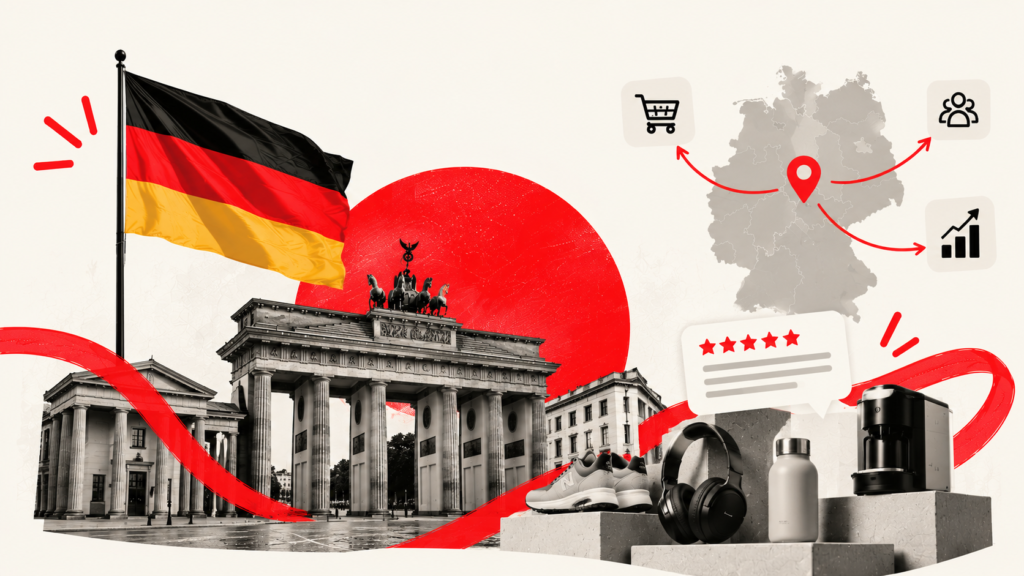
When Chinese brands think about Europe, they often think of the UK first. But Germany, the EU’s largest economy and one of its biggest online retail markets, is often a better fit, especially for brands with strong products and a willingness to prove it. German shoppers research carefully, compare prices and trust independent tests, which makes affiliate and publisher partnerships one of the most effective ways to win them.
Here is what makes the German market different, why affiliate works so well there, and what Chinese brands need to get right.
Germany’s online market at a glance
- Large and growing. German consumers spent €83.1 billion on goods online in 2025, up 3.2% on 2024, according to the German e-commerce association bevh, which expects growth of 3.8% in 2026.
- Frequent, high-value orders. bevh reports that 34.2% of online shoppers order at least twice a week, with an average order value of €146.19.
- Marketplace-led. Online marketplaces accounted for 56% of online retail, or €46.2 billion.
- Open to Chinese sellers. Platforms of Chinese origin accounted for 30% of the growth in German online retail of goods in 2025, according to bevh.
What German shoppers are like
They research before they buy
German consumers are known for careful, informed purchasing. Price comparison is part of everyday shopping: idealo, one of Europe’s leading comparison portals, says it receives more than 96 million page visits a month and lets users compare up to 500 million offers.
They trust independent tests
Independent testing carries unusual weight. Stiftung Warentest, the consumer testing foundation founded in 1964, runs thousands of tests a year. A 2017 Monocle profile reported that 93% of Germans knew it, two thirds trusted its results and a third consulted it before an important purchase. “Testsieger” (test winner) badges from reputable tests and publications are a powerful selling point.
They want to pay in familiar ways
Payment preferences differ from the UK and US. According to the EHI Retail Institute, PayPal accounted for 28.7% of German online retail revenue in 2025 and buying on invoice (Kauf auf Rechnung) for 26.1%, well ahead of credit and debit cards at 13.7%. A checkout without PayPal or invoice options can cost conversions, and publishers notice when their traffic does not convert.
They care about privacy
Germany applies EU data protection rules strictly. Under the TDDDG (formerly the TTDSG), storing or reading cookies and similar data on a user’s device requires prior consent unless it is strictly necessary. This affects how affiliate tracking works, and makes robust, consent-aware tracking essential.
Why affiliate marketing works so well in Germany
Every trait above plays to affiliate’s strengths. German shoppers look for trusted, independent guidance before they buy, and affiliate partners are where they find it.
- Price comparison portals such as idealo put your products in front of shoppers actively comparing options.
- Test and review publishers, including tech and consumer titles such as CHIP, publish reviews and buying guides that shape decisions. See how to get your product into “best of” buying guides.
- Deal communities such as mydealz, part of the Pepper group alongside hotukdeals in the UK, bring highly engaged, price-savvy shoppers, and community approval builds credibility.
- Cashback and loyalty programmes reward shoppers for buying through them and are widely used.
- Creators on YouTube, Instagram and TikTok give products hands-on demonstrations in German.
- A mature affiliate industry. Germany has a long affiliate history. Awin, one of the largest affiliate networks, took its current name in 2017, when the German network zanox and the UK’s Affiliate Window rebranded as one company.
Because most partners are paid on performance, you can test the German market without committing large media budgets upfront. Read why affiliate marketing is the smartest way to enter a new market.
Chinese brands are already winning in Germany
Germany’s demanding shoppers are increasingly choosing Chinese brands where the product is strong. BYD registered 23,306 cars in Germany in 2025 and 26,264 in the first half of 2026 alone, a 318% increase on the same period a year earlier, according to company figures reported in July 2026. In consumer technology, Chinese brands such as Roborock, Dreame and Ecovacs now lead the global robot vacuum market, as we covered in how Chinese brands are going premium in the West.
The lesson is clear: German consumers reward quality and value, wherever a brand comes from, as long as it earns their trust.
What Chinese brands need to get right in Germany
1. Localise properly
Native German product pages, customer service and marketing materials are essential. Machine translation is easy to spot and undermines trust. Adapt the story and proof points for German buyers, not just the words.
2. Lead with proof
Specifications, certifications, warranties and independent test results matter more in Germany than slick advertising. Make them easy to find, for shoppers and for publishers.
3. Offer the payments Germans use
Offer PayPal and, ideally, invoice or buy-now-pay-later options through an established provider, alongside cards.
4. Get compliance right before launch
- Packaging: under the Packaging Act (VerpackG), companies that sell packaged goods to German consumers, including foreign online sellers, generally must register in the LUCID packaging register and join a packaging recycling scheme. Marketplaces often check registration numbers.
- Electronics and batteries: electrical products and batteries have their own registration and take-back obligations.
- Product safety: the EU General Product Safety Regulation requires an EU-based responsible economic operator and clear product information in online listings.
- Your website: German websites need a legal notice (Impressum) and consent-compliant cookie handling.
- Advertising: make sure partners clearly label paid and affiliate content.
This is general information, not legal advice. Take specialist advice for your products.
5. Use tracking that respects consent
Work with a tracking platform that supports server-to-server tracking and consent management, so partners are credited accurately without breaching privacy rules.
6. Build German partner relationships
Many German publishers prefer to work in German and value long-term relationships. Personal introductions, samples for testing and a responsive German-speaking contact make a real difference.
How to launch in Germany with affiliate
- Localise your store, product data and payments.
- Complete packaging, product and electronics compliance.
- Set up consent-aware tracking and a German affiliate programme.
- List on price comparison portals with clean, complete product feeds.
- Seed samples with test and review publishers and creators.
- Add deal communities, cashback and loyalty partners for launch and key sales moments.
- Measure, optimise and expand into Austria and Switzerland, which share the language.
Our step-by-step launch playbook covers each stage in more detail, and UK, EU or US: where to launch first compares Germany’s wider EU market with the UK and US.
Red Thread helps Chinese brands launch in Germany and across Europe with the right publishers, creators and platforms. See our services or book a call.
Planning a launch in Germany? See how we help Chinese brands grow in Europe, or follow our step-by-step guide to launching an affiliate programme in Europe.
FAQs
Is Germany a good market for Chinese brands?
Yes, for brands with strong products. It is a large, growing online market where shoppers reward quality and value, and platforms of Chinese origin already drive a large share of online retail growth.
What are the most important affiliate partners in Germany?
Price comparison portals, test and review publishers, deal communities, cashback and loyalty programmes, and German-speaking creators. The right mix depends on your category.
Do I need to translate my website into German?
Yes. German shoppers and publishers expect native-quality German, and poor translation damages trust and conversion rates.
What is LUCID registration?
LUCID is Germany’s packaging register. Most companies selling packaged goods to German consumers, including foreign online sellers, must register there and join a packaging recycling scheme before selling.
Sources
- bevh figures via beyond-print: German e-commerce grows more strongly in 2025 (January 2026)
- Productsup: idealo partner profile
- Monocle: Stiftung Warentest profile (2017)
- IT Finanzmagazin: EHI study Online-Payment 2026 (May 2026)
- CMS: Tracking according to the ePrivacy Directive and German law
- Wikipedia: hotukdeals and the Pepper group
- Awin: zanox and Affiliate Window rebrand to Awin (2017)
- BYD Germany sales on track to more than double 2025 levels (July 2026)
- Ecosistant: LUCID packaging register guide