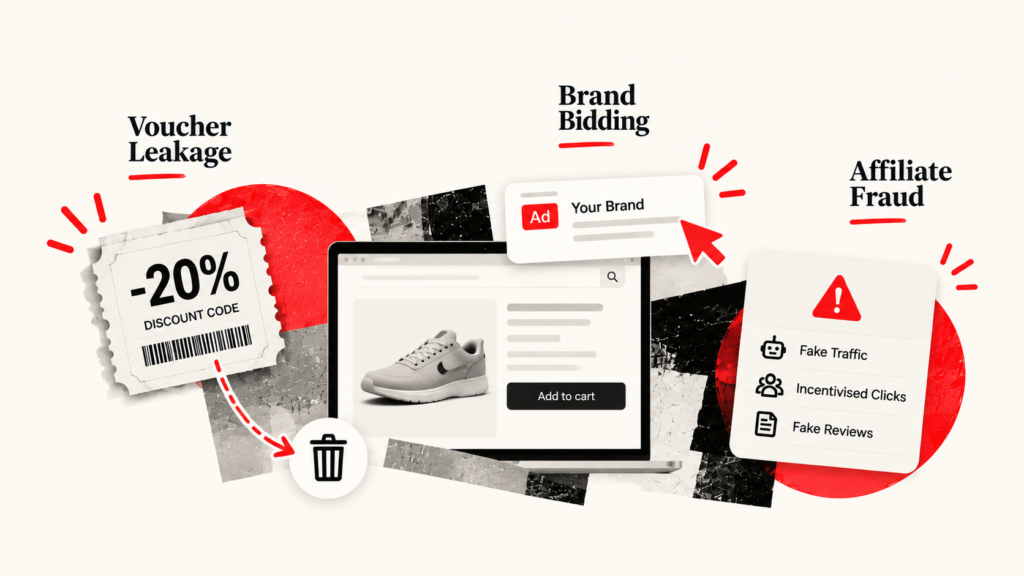
Affiliate marketing should pay partners for sales they genuinely help create. But without the right rules and monitoring, a programme can quietly end up paying commission on customers who were already buying, giving discounts to people who did not need them, or rewarding outright fraud.
For a brand entering a new market, where budgets are tight and every euro, pound or dollar has to prove itself, these leaks matter. Here are the three biggest threats to your margin (voucher leakage, brand bidding and affiliate fraud) and how to protect against each one without damaging relationships with your genuine partners.
1. Voucher leakage
What it is
Voucher leakage happens when a discount code intended for a specific audience, such as a creator’s followers, a loyalty scheme or a closed user group, ends up on public voucher sites and browser extensions. Shoppers who were already on your checkout page find the code, apply it and buy, and a partner who did nothing to win that sale can still earn commission on it.
Why it hurts
- You give away a discount to customers who would have paid full price.
- You may also pay commission on the same sale.
- The partner who created the demand, such as the creator whose code it was, can lose the credit.
How to prevent it
- Use unique or single-use codes for private audiences, and generic codes only where you are happy for them to be public.
- Assign codes to partners in your tracking platform, and state in your terms that commission is only paid to the partner a code belongs to.
- Set short expiry dates on campaign codes, and retire them after the campaign.
- Monitor voucher sites for codes that should not be public, and ask partners to remove them.
- Give voucher partners their own codes with clear terms, so they have a legitimate offer to promote instead of leaked ones.
2. Brand bidding
What it is
Brand bidding is when a partner buys search ads on your brand name, for example “YourBrand” or “YourBrand discount code”, and sends that traffic through their affiliate link. The shopper was already searching for you, so the partner is often intercepting a sale you would have won anyway.
Why it hurts
- You pay commission on customers who were already looking for your brand.
- Partners bidding against your own search ads can push up what you pay per click.
- Ads that misuse your brand name or make unapproved claims can confuse shoppers.
Search engines generally do not stop other advertisers bidding on your brand name as a keyword, and their rules on trademarks in ad text vary by region. That makes your own programme terms, and how you enforce them, the main protection.
How to prevent it
- Ban brand bidding in your programme terms, covering your brand name, misspellings and combinations such as “discount” or “voucher code”.
- Ask search partners to add your brand as a negative keyword.
- Monitor search results in each market, using manual checks or a monitoring tool, and reverse commission on sales that break your terms.
- Allow exceptions deliberately. If competitors are bidding on your brand, you may choose to let one trusted partner bid under agreed conditions. Make it a decision, not an accident.
3. Affiliate fraud
Most partners are honest, but any programme that pays on results attracts some people who try to game it. Common types include:
- Cookie stuffing: secretly placing affiliate tracking cookies on shoppers’ browsers without a genuine click, so the fraudster gets credit for sales they had nothing to do with.
- Checkout hijacking: software or extensions that insert their own affiliate tracking at the last moment before purchase, taking credit from the partner who actually influenced the sale.
- Fake or fraudulent orders: transactions using stolen card details or made purely to trigger commission, which are later cancelled or charged back.
- Self-referral and incentive abuse: partners buying through their own links, or paying people to buy and return products, in breach of terms.
- Fake leads and bot traffic: automated sign-ups or clicks in cost-per-lead or cost-per-click programmes.
- Brand impersonation: websites or social accounts that copy your brand, or use lookalike domains, to capture traffic.
A real-world example
Affiliate fraud can be serious. In one well-known US case, a former eBay affiliate was sentenced to 15 months in federal prison in 2014 for a cookie-stuffing scheme. According to the US Department of Justice, code in his free applications placed eBay tracking cookies on users’ browsers “even though the user did not click on an eBay ad or link”, generating fraudulent commissions.
Warning signs to watch for
- Conversion rates far higher than similar partners.
- Very short times between click and purchase, especially sales that start at the checkout page.
- High cancellation, return or chargeback rates from one partner.
- Traffic from countries or devices that do not match the partner’s audience.
- A sudden spike in sales from a new or small partner.
- A partner who cannot clearly explain where their traffic comes from.
How to prevent it
- Vet partners before approving them. Check their site, audience and promotional methods.
- Use a validation period. Confirm orders before paying commission, so returns, cancellations and fraudulent orders can be reversed.
- Use your platform’s fraud tools and review suspicious activity reports regularly.
- Write clear terms that list prohibited methods and let you withhold commission and remove partners who break them.
- Audit your top partners periodically: where their traffic comes from and how they promote you.
Measure what partners really add
Many margin leaks survive because last-click reporting gives all the credit to whichever partner was last in the journey. Look beyond last click at the share of new customers each partner brings, their place in the customer journey, and incrementality tests where you can run them. Partners that genuinely create demand deserve the best rates; partners that only capture existing demand should be paid accordingly. Our affiliate marketing glossary explains these terms, and how affiliate deals are priced covers tiered and new-customer commission rates.
Do not throw out good partners
Voucher, cashback and loyalty partners are not the problem. Well managed, they help convert hesitant shoppers, drive volume at key sales moments and reach valuable audiences. The goal is not to cut them out but to set fair rules, pay for genuine value and make sure every partner competes on the same terms.
A margin protection checklist
- Programme terms that cover vouchers, brand bidding, prohibited methods and commission reversals.
- Unique, partner-assigned codes for private audiences.
- Brand bidding banned by default, with deliberate exceptions only.
- Partner vetting before approval.
- A validation period before commission is paid.
- Regular monitoring of voucher sites, search results and fraud reports.
- New-customer and incrementality measurement alongside last click.
How Red Thread helps
Protecting margin is part of running a programme properly. As an OPM agency, Red Thread writes programme terms, vets partners, manages codes and monitors for leakage and fraud, so Chinese brands entering the West pay for growth, not leaks. See our services or book a call.
Want a team to protect your programme? See our affiliate programme management service, or talk to us.
FAQs
What is voucher leakage in affiliate marketing?
It is when discount codes meant for a specific audience spread to public voucher sites or browser extensions, so shoppers who were already buying get a discount and a partner can earn commission they did not really earn.
Should I allow affiliates to bid on my brand name?
Usually not. Most brands ban brand bidding by default, because those shoppers were already looking for you. Some make a controlled exception for one trusted partner if competitors are bidding on their brand.
How common is affiliate fraud?
Most partners are genuine, but any pay-for-results programme attracts some fraud. Partner vetting, a validation period, fraud tools and regular audits keep it under control.