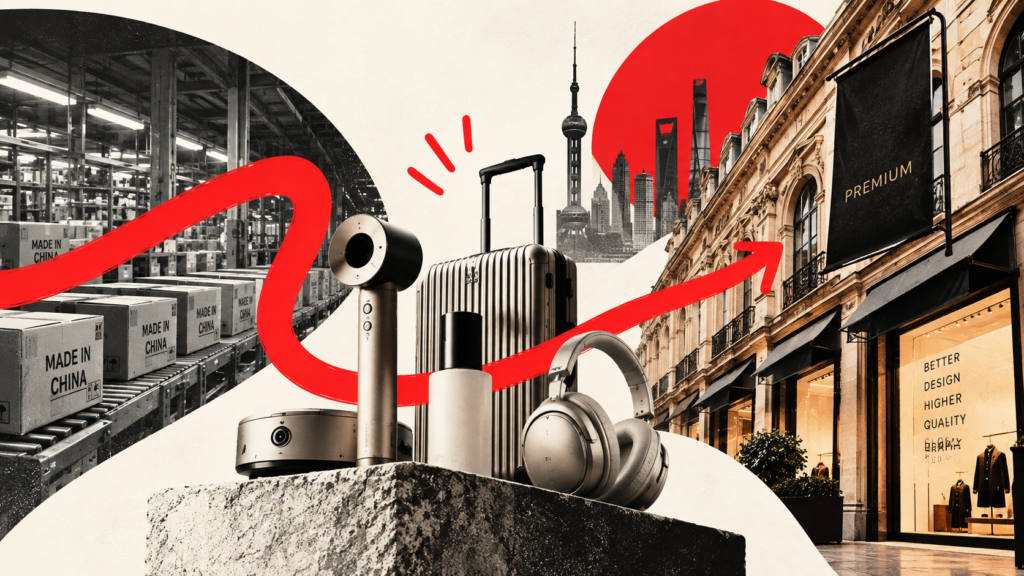
For years, “made in China” meant one thing to Western shoppers: cheap. That is changing fast. A new generation of Chinese brands is winning in the UK, Europe and the US on design, technology and brand love, and many of them now sit at the premium end of their categories.
This shift matters for any Chinese brand planning Western growth. The playbook that built the first wave of exports (low prices, marketplace listings, volume) will not build the next one. Here is what is happening, why, and what it means for how you enter the market.
Chinese brands are becoming household names
Kantar’s latest BrandZ ranking of the Top 50 Chinese Global Brands, published in August 2026, found that the brands on the list grew their total brand equity by 7% year on year across 11 international markets. The leaders span entertainment, electronics, fashion and home appliances: TikTok, Xiaomi, SHEIN, Lenovo, Huawei, Haier and AliExpress.
The more telling finding is about how Western consumers now judge value. Kantar reports that shoppers increasingly recognise that “cheapest is no longer the same as best value”. They will pay for products that last longer, work better or look better, even when budgets are tight. That is exactly the space where the strongest Chinese brands are competing.
Three categories where the shift is already clear
Electric vehicles
In April 2025, BYD registered more pure electric cars in Europe than Tesla for the first time, according to JATO Dynamics. BYD’s registrations rose 359% year on year across 28 European markets, while Tesla’s fell 49%. JATO’s analyst called it “a watershed moment for Europe’s car market”, all the more striking because BYD only expanded beyond Norway and the Netherlands in late 2022.
Smart home
Robot vacuums tell the same story. IDC reports that the top five smart vacuum brands in the world are now all Chinese: Roborock, Ecovacs, Dreame, Xiaomi and Narwal. Global shipments reached 17.42 million units in the first three quarters of 2025, up 18.7%. Meanwhile iRobot, the American brand that created the category, filed for Chapter 11 and agreed to be acquired by its main Chinese manufacturer.
Crucially, these brands did not win on price alone. They won on faster product cycles and better specifications at every price point, from entry models to flagships that cost as much as any Western rival.
Culture and collectibles
Pop Mart shows how far a Chinese brand can go on desire rather than discount. The company’s 2024 revenue from outside mainland China grew 375% to around 5 billion yuan (about US$700 million), nearly 40% of its total. Its Monsters range, home of Labubu, grew 726.6% in a year. Prices run from about US$5 to more than US$1,500, and the company has opened stores in cities including London.
Why this is happening now
- Product quality has caught up, and often overtaken. In electronics, appliances and EVs, Chinese brands frequently lead on specification.
- Brands are investing in brand, not just distribution. Hisense, ranked in Kantar’s top 10 Chinese global brand builders for nine years running, says its overseas brand awareness rose from 30% in 2018 to 56% in 2024, helped by major sports sponsorships.
- The ultra-low-cost model is under pressure. The US ended its US$800 “de minimis” duty exemption for parcels from China and Hong Kong on 2 May 2025. Competing on the cheapest possible price is harder; competing on brand is more valuable.
- Western consumers are more open. Younger shoppers in particular care about the product and the community around it, not where the head office is.
What premium positioning demands in the West
Moving upmarket changes what you need from your go-to-market. A premium price has to be earned with trust, and trust in the West is built through people consumers already listen to.
- Credible third-party voices. Reviews on trusted editorial sites, recommendations from creators and coverage in the right publications do more for a premium launch than paid social alone.
- Localised storytelling. Kantar names deep localisation as one of three growth imperatives for Chinese brands. Translation is not enough; the story, proof points and tone need to fit each market.
- Compliance done properly. From the EU’s General Product Safety Regulation to UK and US advertising disclosure rules, premium brands cannot afford shortcuts.
- Partners who protect the brand. Heavy discounting through the wrong channels can undo years of brand building. Choose partners, placements and offers that match your positioning.
Where affiliate and publisher partnerships fit
This is why we believe partnerships are the fastest route to premium growth in the West. Affiliate and publisher partnerships put your products in front of Western consumers through the voices they already trust: editorial review sites, content creators, loyalty communities and more. And because most of these partnerships are paid on performance, you invest as you grow.
Read more in why affiliate marketing is the smartest way to enter a new market, or see how we help brands in our services.
Building a premium brand in the West? See how our affiliate marketing service helps Chinese brands win trust with Western shoppers in the US, UK and Europe.
FAQs
Are Chinese brands seen as premium in the West?
Increasingly, yes, in categories where they lead on product. EVs, smart home, consumer electronics and collectibles are clear examples. Perception still varies by category and market, so positioning has to be earned through proof, reviews and trusted recommendations.
What is the biggest mistake Chinese brands make when entering the West?
Treating it as a distribution problem rather than a trust problem. Listing on marketplaces and discounting can drive early sales, but it rarely builds a brand that can hold a premium price.
Which Western markets should a Chinese brand enter first?
It depends on the category, but the UK is often a strong first market: English-speaking, highly online, with a mature affiliate and publisher ecosystem that makes it easier to test, learn and then expand into the EU and US.
Sources
- Kantar: Made in China – how Chinese brands are redefining global growth (August 2026)
- JATO Dynamics: BYD outsells Tesla in Europe for the first time (May 2025)
- IDC: The rise of Chinese smart vacuum giants (December 2025)
- TIME: Inside Pop Mart’s global toy takeover (March 2025)
- Hisense: Top 10 in Kantar BrandZ Chinese Global Brand Builders 2025 (July 2025)
- FashionUnited: End of the US de minimis exemption for goods from China (May 2025)